Sunday, December 30, 2018

Chinese vs American Schools -- There are Big Differences!


Ever Wonder….?

…what the differences are between schools in China and schools in America?  Between study habits of Chinese students and American students?

I get that question often from my Chinese students, so I prepared a lesson about it.  So if you've ever wondered the same thing…read on…and be amazed at the differences!

Cohort concept
One of the main differences I have run across in China is the concept of cohorts (standard groups). All students are placed in classes the first year of each school (primary, middle and high school, as well as at the university level), and they generally remain in that cohort for the full time they are in that school. Occasionally there is movement between cohorts based on year-end test scores, but that is not very common.

Of course, that does not happen in America, except in schools with limited enrollment. There is a bit of a cohort concept for AP / Honors classes, but that is generally due to a lack of multiple course offerings and usually applies only to those upper-level courses.

School Years
Chinese students are generally in class about the same number of weeks per year as American students.

American schools generally run from mid-August to late May / early June.

Chinese schools generally run from late August to early / mid-July.

Chinese schools have winter holiday (called winter festival) from January 1 until late February.


School uniforms
Chinese schools still require their students to wear school uniforms. One of the random questions students drew to answer for me during their final oral exams this semester was: “Describe your clothes.” One young woman who drew this question did a fine job, detailing where she had purchased her blouse, pants, tennis shoes and jacket, and why she liked them. She told me her jacket was the jacket from her middle school uniform. She said she really loved the colors, as compared to her high school uniform, which was mostly white, and in her opinion, “Very bland.” J


Note the red scarf all the students are wearing. This is a mandatory aspect of their school uniform in primary (elementary) and middle school throughout China. It symbolizes loyalty to China, particularly the Chinese flag. I have seen it compared to the daily recitation of our Pledge of Allegiance in classrooms. A half generation ago it symbolized the student had joined the Communist Youth movement, but I understand that is no longer necessarily the case.


(The five stars on China's flag represent the Communist party [the largest star], workers, soldiers, students and farmers.)

American schools do not generally require school uniforms, though some private schools and schools run by religious institutions still require it.

School day
This is an area of huge difference I found between Chinese and American schools. I think the school district where our children went to school is fairly representative of American school schedules.  All are between a 6 hour, 45-minute day (elementary school) and a seven-hour, ten-minute day (high school), with hours generally around 8:30am to about 3:30pm.  Studies in the U.S. show high school students have an average of about 3.5 hours of homework per week.

This next bit is HUGE -- virtually all Chinese high school students leave home to go to high school, and live in dormitories provided on or very near campus – this is a huge difference. Depending on the test score they receive at the end of their ninth-grade year, they are assigned to a high school, and most often it is nowhere near their home. So that means 15-year-old soon-to-be high school students bid their parents (and grandparents) adieu, and head off to school. The distances are usually too far for their parents to see them other than during holidays (or festivals, as they are called here).

The Chinese high schooler's day is rigorous. Students typically arrive in their classroom at 6:30am or 7:00am where they study under an adult's watchful care until their teacher arrives at 8:00am. The teacher teaches until noon, when students return to their dormitories for two hours, to eat and take a nap. They return to school at 2:00pm, then are in class until 5:30pm. They take an hour and a half dinner break, and then are back in their classroom at 7:00pm for teacher-monitored studying until 10:00pm. One of my students told me if you want to study when you return to your dorm, that is up to you.

One article I read indicated this schedule went on six days a week – school was from Monday through Saturday. I taught this lesson to a class of graduate students, and they told me that was not correct -- they were in class seven days a week, and that they got two weekend days off once a month. One student in that class said she got two weekend days off twice a month, and her classmates razzed her for having had it easy!

Curriculum
Another difference between Chinese schools and American schools is that the curriculum in China is government administered...and is somewhat of a one-size-fits-all curriculum. There are very few electives available at any of the levels of school.

Curricula in American schools is set by the school districts, and usually include a variety of elective courses that may be taken.

The Chinese curriculum is focused on learning facts, fact, facts. Students routinely memorize pages and pages of their textbooks in preparation for tests they will be taking.

The ability to memorize and regurgitate facts is why China's math students excel in competitions and exams -- they have learned the knowledge backwards and forwards.

But a big difference in the curricula between America and China is the application of the information!  American curricula provide knowledge, but also encourage teamwork, cooperation, critical thinking and problem-solving skills, as well as application of the knowledge learned.  Those characteristics are not what the Chinese curriculum is about.  But boy, can they take and pass tests!

Good in Math vs Bad in Math
Perhaps you read my recent post about stereotypes (Travel is Fatal to Prejudice, Bigotry and Narrow-mindedness, November 8, 2018), a lesson I taught to all my university classes.  One of the things that came out of that is that Chinese are very (rightfully) proud of their academic achievement in the area of Mathematics, and generally consider Americans as being weak in this area.

I went online and did some research. I discovered that there is a math competition called the International Mathematical Olympiad, which is the quintessential math competition for pre-college students.  The Olympiad has been running since 1959 -- fifty-nine years (if I did the math right!).  Teams from China have won that competition nineteen times...and they didn't participate during the first 30 years!  So they have won the gold medal nineteen of the twenty-nine years they sent teams!  That includes twelve victories since 2000.

America hasn't fared so well...but we are improving. We have won seven times in the fifty-nine years we competed.  However, we have won three times in the last five years, including in 2018.

But remember the previous section on Curricula? How China's curriculum teaches their students to pass tests, while America's curricula teaches her students how to apply the knowledge?  I found some other interesting information about that.  Each year since 1901, there has been a Nobel Prize in Physics awarded to deserving (and brilliant) physicists.  Since 1901, Chinese scholars have won three Nobel Prizes, two of which were won in Physics in 1957.  Americans have won 336 Nobel Prizes since 1901, ninety-one of them in Physics, and twenty-six of them since 2000.  Americans have won Nobel Prizes in Economics fifty-seven times and Chemistry seventy-three times.  A Chinese citizen won the Nobel Peace Prize in 2010.

So while many Chinese students are absolutely brilliant in the field of mathematics, Americans are far better at using and applying that knowledge to solve problems.

I could go on and on, but let me leave just a bullet point list of other differences between Chinese and American education systems:

  • Chinese teachers typically remain with their cohort of students from first to sixth grades,
    seventh to ninth and tenth to twelfth grades; their teachers teach all subjects.
  • Chinese teachers come to students -- students remain in their classrooms and teachers rotate.
  • Chinese Kindergarten costs $500 to $5,000 per year; primary and middle schools are free, and high school is about $700 per year (which includes room and board in their dormitories). Chinese Kindergartens are for children 3, 4 and 5. The first two years are analogous to U.S pre-schools. 
  • Chinese universities are much cheaper than in the US.  At the university where I teach, tuition, room and board runs between $1,000 and $2,300 per year, depending on the student's assigned major.
  • Grades of each student are posted for all to see.
  • As you might expect, Chinese schools have a huge emphasis on unity and uniformity (collectivism).
  • Chinese students all take the same courses and tests.
  • Class sizes are larger in Chinese schools than American schools. Class sizes in primary, middle and high schools usually range between 55 and 65 students. University class sizes are about the same, although some classes number in the hundreds (several cohorts).
  • Non-academic activities (dances, homecoming, prom, athletic events, drama, etc.) are not a priority in China, and often not even available. They are seldom participated in.  Academics is the primary focus.
  • At the end of their senior year, nearly 10,000,000 Chinese students take the Gaokao (rhymes with cow-cow) -- a standardized test that will determine their futures.  Depending on their score, they will be assigned a university and major. Students are vying for 7,000,000 slots at Chinese universities; those who don't make the cut won't be going to college.


Sunday, December 23, 2018

Going with the Flow...Poetry...and Gifts

One of the main tenets of the religion / philosophical tradition of Taoism (aka Daoism) is to be in harmony with "The Way" (the unplanned rhythms of the universe), and it is a major influence in China.  If we are observant,we can see it all around us in China.

When we first arrived here, the traffic seemed chaotic and unorganized, and we marveled at how very few accidents (very few) we saw.  But as we have become more accustomed to the traffic patterns, we realized that there is a certain...order?...to the chaos -- people just go with the flow -- and it works.  Traffic flows rapidly and smoothly, a must in this city of nearly seven million people.

(Sorry for the poor quality of the pictures -- they were taken through the window of a bus...)

Rush hour, outside our hotel.

As I was thinking about this one afternoon on my way across campus, I noticed some of the sidewalks in the area. Jinan -- and our campus -- has many, many trees.  Anyone who has trees in their yard knows that roots can wreak havoc with concrete sidewalks and streets -- causing upheavals, cracks and dangerous situations.  And so it is in Jinan -- tree roots grow up and try to shove their way through the sidewalks.


The Chinese / Taoist answer? Go with the flow.  On our campus as well as across Jinan, none of the sidewalks that form a border between the streets and the trees is paved with concrete -- instead, they use paving stones of varying sizes. These stones allow the sidewalks to flex as the roots beneath them reach skyward.

Once the sidewalks get hazardous, a group of laborers shows up with shovels, picks and various other hand tools.  They remove the displaced stones, trim down the roots, and then replace the dirt and stones until all is good as new!

(Sorry -- I didn't get a before-and-after picture...but believe me -- it is as good as new!)

*********************************************************************************

About a month ago, Bonita developed a wonderful lesson about the Disney hero Moana and how she came to know who she was.  We both used it in our classes. We shared a short clip from the Moana movie, then invited the students to reflect on their own lives, and see if they could discover who they were.  Then we provided a template for an "I Am" poem. The results were remarkable.  Insightful. Deep. Searching. Beautiful. Truly, many of the students spoke with their heart's voice. Here are a few of the poems:

I am the daughter of China
I am optimistic and kind-hearted
I wonder if I will be the person I want to be
I need more courage
I see my bright future
I am optimistic and kind-hearted

I feel so much love
I hate being cheated
I want to make the world a better place
I cry when I fail
I worry about uncertainty
I am optimistic and kind-hearted

I say no to compromise
I understand that being successful is not easy
I fear loneliness and death
I try everything I can
I hope to love and be loved
I am optimistic and kind-hearted
                                  -- Veronica (Li Jia Yi)

I am the daughter of Guang Xu and Mei Yu
I am freedom-loving and optimistic
I wonder if my dreams cannot be true?
I need to chase it!
I see I am jumping out of my skin
I am freedom-loving and optimistic!

I hate to be alive like a bird in a cage!
I want to walk every place!
I cry sometimes because I am a little weak
I worry if I can do it
I am freedom-loving and optimistic!

I say, "Hi, difficulties! You cannot beat me!"
I understand life will always be imperfect
I fear to say goodbye
I try to cherish what I am now!
I hope to be 20 forever!!!
I am freedom-loving and optimistic!
                                  -- Judy (Xu Ting)

I am the son of Pachangol
I am upright and brave
I wonder how my future life will be
I need more perseverance when I meet with difficulties
I see the goodness of my life every day
I am upright and brave

I feel proud when I see the fabulous views of my country
I hate the persons who hurt others for their own benefit
I want to assist my country to be more and more strong
I cry when there's nothing I can do when in trouble
I worry that I will fall behind in my studies
I am upright and brave

I say "I am the Best!" to cheer me up every morning
I understand the pressure of my parents
I fear people will be embarrassed because of me
I try to modify every shortcoming that I have
I hope that the world can be at peace forever
I am upright and brave
                                                Juarry (Zhang Jiarui)

Finally, following is the poem of Doris (Cao Jiamiao), a beautiful daughter of China and gifted poet and artisan:

I am the daughter of Cao Yueyi and Xin Ruilan
I am fantastic and insecurity
I wonder if there is life outside the earth
I need to love and to be loved
I see different colors in the air
I am fantastic and insecurity

I feel indeterminate of my life
I hate darkness, loneliness and being hurt
I want braveness, sunshine and moonlight
I worry when I am lost
I am fantastic and insecurity

I say hello to myself every morning
I understand why there is poetry in the wind
I fear the unknown
I try to make myself better though I fail
I hope I can see you in my dream
I am fantastic and insecurity
I am Doris
                                      -- Doris (Cao Jiamiao)


Doris is in one of my Freshmen Business English classes.  Her poem touched my heart.  I was also touched by several gifts she gave me, as she demonstrated other artistic talents she has. The first was earlier this semester, when she gave me a lovely, delicate paper-cut bookmark she had crafted (the red is cut out and pasted on the white):

 As a special bonus, she also made the presentation box:


This past week, she also gave me a beautiful calligraphy work she did of two Chinese words: Safe and Happiness, which symbolize Good Wishes.


My students are so kind-hearted and good, so giving. In addition to Doris's gifts, I have received lots of food, Bonita and I were taken to dinner by several groups of my students, and other gifts like a lovely journal one young woman gave me. Last week, another student (Jessie, Li Xiao Shuang) gave me a cute Christmas / Santa diorama.  Once I brought it home, Bonita looked at it very closely and noticed that the figures were made from sculpting clay...my student had crafted the figures. I asked Jessie about it, and she said it took her a week to do them!  I am so glad Bonita noticed and realized Jessie had hand-crafted these items.


Over the past two weeks I have met one-on-one with my students, doing five-minute oral exams with each of them. It has been a sweet, warm opportunity to spend time one-on-one with each of them. I have learned so many things about them personally, have seen their tears as they speak of love for their mothers and fathers, tears for the stress they feel at times to never let their parents or themselves down. I have done about 250 oral exams and will finish the last forty or so later this week. It has been a remarkable experience, to say the least!

And now for some other, random pictures of our time here. The first few pictures were taken at Baotu Springs, a famous local park which has become a favorite of ours:

Statue at Baotu Springs, Jinan


Canal across from Baotu Springs, on our way to WalMart last week.

We stopped at the Shandong Provincial Museum a week or so ago, and it was absolutely fascinating. We are looking forward to returning some time soon!
No -- we were not kidnapped by a UFO -- The ceiling of the Grand Gallery of the SPM

Grandfather adjusting his grandson's coat on the staircase of the Grand Gallery at the SPM


Ancient painting entitled The Gods
Beautiful painting

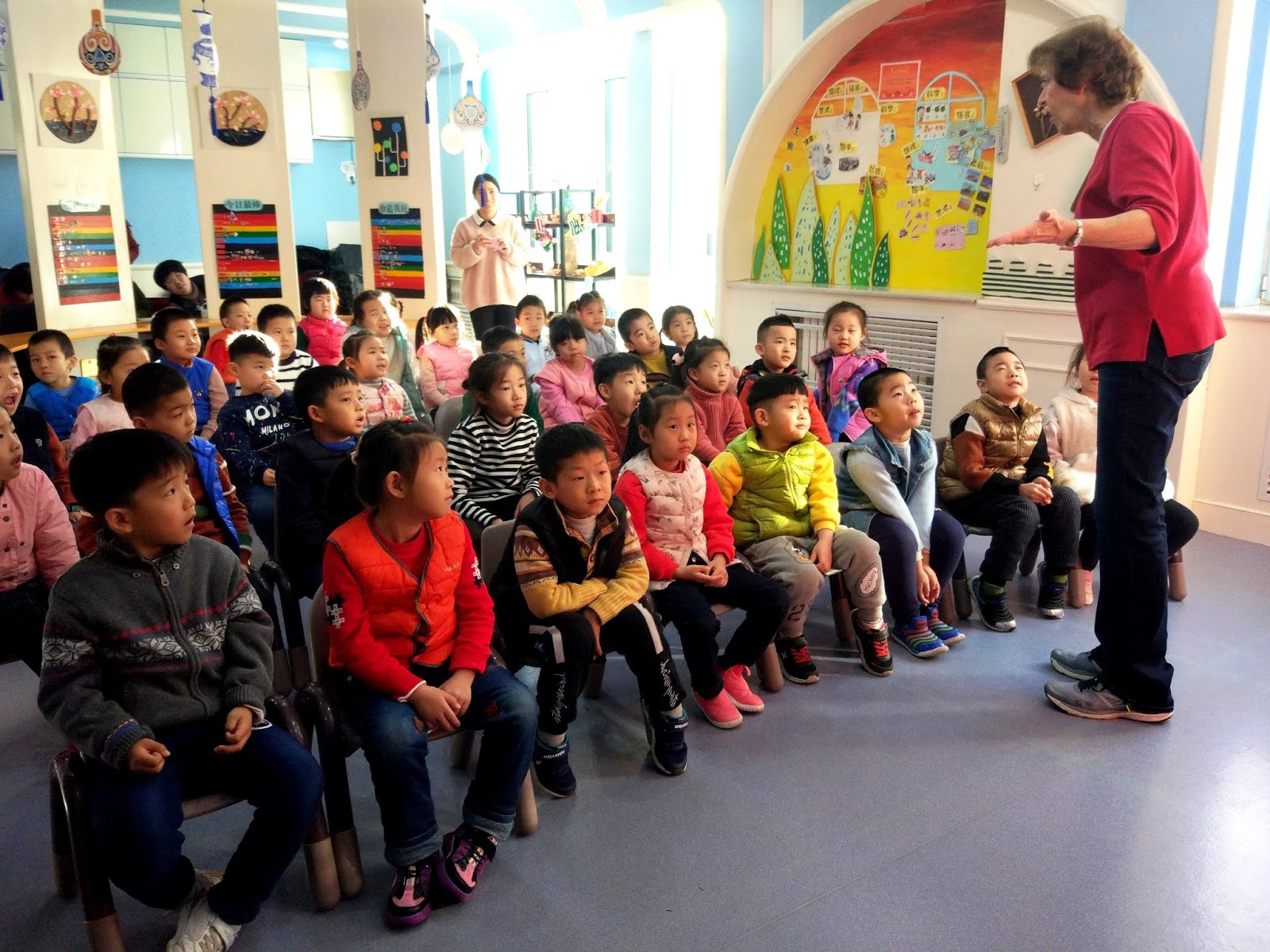
Recently, Bonita and I had the opportunity to visit a Kindergarten class. Here she is teaching them about Christmas.  I taught them a couple magic tricks appropriate for 5-year-olds, with which they can amaze their friends and family.


Finally -- here are a couple Christmas trees in our lives this year. The first is out front of the hotel in which we are staying, the second is in our apartment:


Merry Christmas from China!

Wednesday, November 21, 2018

Pictures, Pictures and More Pictures

Some of the other BYU China Teachers Program (CTP) teachers are also posting to blogs of their adventures in China.  One of them almost exclusively posts only pictures with captions in her blog.  While I don't want to do that exclusively, I thought it might be nice to do that every once in a while -- they are a little quicker to read.

So, with that introduction, following are a few pictures of mine and Bonita's adventures the three months we have been in China:

This was taken at Daming Lake, a magnificent park in the midst of  a city of 7 million souls where they can go and commune with nature for a while.  I liked the colors in this picture...I call it Red and Green.
Speaking of the color Red, when we visited the Temple of Heaven in Beijing in 2016, I took this picture, titled Red and Gray:


Getting artsy with some (very uncomfortable) benches along Daming Lake.

Fall finally fell here at our campus in Jinan the past couple weeks, about a month later than it did back home in Colorado.  Here's hoping spring arrives a month earlier than back home!
When we were on a trip in western China, we visited one of the finest museums I've ever been to -- it was in a town called Urumqi (pronounced Ooh-room'-chee). They had a number of mummies that were remarkably well preserved --  not by professional embalmers, like the Egyptian mummies had, but by the dry climate of the Gobi Desert (which is in western China).


The picture on the right is an artist's conception of what the woman on the left may have looked like in real life (it is believed this area of China was inhabited by Celtic peoples at the time of this woman's death -- 3,800 years' ago).  If you look closely at the mummy, you can see her long eyelashes -- still intact!  Amazing.

Another well-preserved mummy, inside the wood coffin in which he was buried:


A common sight along the streets -- this fellow repairs bicycle / electric bicycle tires and shoes.  I had a small tear in one of my leather shoes, and it was expertly fixed by one of these vendors.  The cost?  5 Yuan (about 75 cents).
Bonita shopping in the local produce section.  Actually, the grocery stores do have produce sections...but these small carts can be seen all over the city.
Wash day at the girls' dormitory on campus, across from the back of our hotel.

I had to deal with a broken tooth last week. Dentists are employed by the hospitals (therefore, they are Civil Servants, since healthcare -- including dentistry -- is nationalized).  So when you need to see a dentist, you go to the hospital.  This is where you will receive your dental care.  The room was about 140' long by 32' wide.  There are 42 cubicles in this area (you can't see the cubicles along the left wall due to the dental personnel in the way).  The equipment appeared to be fairly modern, and the dentist competent and efficient.  It was shift change when I took this picture, so the cadre of dental assistants and dental hygienists that work with the dentists in the middle of the picture were being given their instructions and assignments for the day:


A couple weeks' ago, we took a bus trip to the mountains to a place called Red Leaf Valley Park -- about 90 minutes away from Jinan to "see the colors" -- similar to going up into the Colorado mountains to see the aspen change in the fall.  Alas, we were about a week or ten days too late to see much color, but it was nice being in the mountains during the fall -- the clear, crisp air, the long views, etc. Wish I'd have had my elk bugle (or at least cow call) to make a little noise!  Made me miss the Colorado mountains within which I have spent many a day hunting.  I thought the views looked very much like some areas of Colorado and Utah I have hunted.
While parts of the park looked like Colorado and Utah, the lake area at Red Leaf Valley Park had that quintessential Chinese feel. You can see how stunning it would have been a couple weeks' earlier with all the grey flora covered in reds and golds!
Home sweet home -- our front (and only) door to our apartment: Room 720, Hanlin Hotel, Jinan, China.


Finally, one of our favorite pictures of ourselves in China so far was taken by one of the other CTP teachers in Yar City in western China:
Bonita and I walking off into the sunset at Yar City the first week of October.

Thursday, November 8, 2018

Travel is fatal to prejudice, bigotry, and narrow-mindedness...

Travel is fatal to prejudice, bigotry, and narrow-mindedness, 
and many of our people need it sorely on these accounts. (Mark Twain, Innocents Abroad, 1869)

Twain was right when he said this 150 years' ago, and it applies now as well.

It seems to me we are all guilty to one degree or another of holding stereotypes about others.

So...what stereotypes do you hold for Chinese people?  Come on -- you know you have them.  Before reading further, pause a moment and think what those stereotypes might be.  Then -- read on.

This past month across all seven of my classes, I taught a wonderful, insightful, thoughtful and engaging lesson.  The wonder, insights, thoughtfulness and engagement were not my doing -- it was from 290 students: about 80 freshmen (17 and 18 year olds), 182 sophomores (ages 18 -- 20) and 28 graduate students (23-26).

After introducing Stereotype as our new Word of the Day, I asked them the following question:

              1.  What stereotypes do Chinese people have of Americans?

The students worked in teams of four to come up with a list of ten to fifteen items for each team. Then, a representative of the team went to the chalkboard and posted their entries:


Some of their answers were predictable, while others were surprising, funny, spot-on and frankly, humbling.

Here are some of the more predictable answers they provided for Chinese stereotypes of Americans:

All Americans:

-- are tall                                 -- live in large houses
-- are strong                           -- have guns
-- are overweight (sigh...)   -- have a high crime rate
-- like fast food                      -- like fast food
-- are rich

In addition to those stereotypes, their comments were surprisingly generous and complimentary of the quality and character of Americans:

-- enthusiastic                        -- humorous
-- independent                       -- outgoing
-- adventurous                       -- heroism
-- open minded                      -- healthy
-- direct communication      -- genuine
-- optimistic                            -- smart
-- generous                              -- innovative
-- police force for the world -- creative
-- open                                      -- open
-- free                                        -- pay attention to human rights
-- democratic                           -- blunt

Some were funny:

-- all the men are handsome  -- bad at math
-- high nose*                              -- don't like Friday the 13th
-- love to get a tan                     -- Super heroes
-- creasy**                                  -- drink cold water (blows their minds!)
-- like hamburgers and cola (I think they were disappointed when I told them the last cola I had was when I was 17 or 18...)
-- gold hair and white skin     -- rich in body language (Chinese are generally not -- although that's a stereotype, isn't it?!)
-- sparkling skin                       -- abundant facial expressions ("     "    "      "    "    "    "     "     "     "     "     "     "     "     "    "      ")
-- curly blonde hair and beautiful blue eyes
-- have big eyes                         -- many pets
-- broad shoulders                   -- pets are like family members

Editor's notes:
     -- * - they are referring to the high nose bridges many Americans have (particularly compared to Asian nose bridges)
     -- ** - they are referring to the creases many Americans have on their faces...(aka wrinkles!)

And there were a few negatives (but very few):

-- arrogant
-- conceited
-- high divorce rate
-- live from paycheck to paycheck
-- family indifference to parents and grandparents
-- kick you out when you turn 18
-- racist (they are convinced that all Americans are racist...)

Of the above negative viewpoints, all appeared only once during the lessons, except racism. It was a frequent negative that was posted -- maybe fifteen or twenty times across 70 teams. (Actually, the comment about not taking care of our elderly was made three or four times, not just once.)

It is obvious many of their stereotypes come from watching American movies, TV shows and CNN.


After they were finished with the Chinese views of Americans (we discussed and I provided some insights on a number of their stereotypes), I asked the following question:

              1.  What stereotypes do Americans have of Chinese?

Once again, they went to their teams to come up with lists, then posted their entries on the blackboards.

Here are some of the more predictable answers they had:


All Chinese:

-- know Kung Fu
-- have black hair and eyes
-- are short
-- are good students, particularly in math
-- take care of their families, particularly the elderly

(FYI -- out of seven classes and 290 students, only about four said they knew Kung Fu.  And many Chinese are tall -- nearly every class I teach has young men and young women as tall as me -- or taller!)

Other stereotypes they thought Americans held about Chinese included:

-- shy                           -- they speak Chinglish
-- polite                       -- conservative
-- aggressive               -- yellow skin
-- traditional               -- long history
-- united                       -- live in flats (apartments)
-- collectivism             -- cheap labor
-- one-child policy      -- copy technology from America
-- large population     -- dictatorship

As I mentioned at the outset, it was a wonderful, insightful few days with my students, and a lesson I will long remember!  I don't know about you, but this series of lessons across seven classes of students caused me to want to be more...thoughtful...and cautious about the stereotypes I have of groups of people.
*********************************************************************************
Here are a few other photos for your enjoyment:

Five freshmen roommates / classmates [Xu Xin Hang (Elena), Wang Run Xiao (Carol), Liu Chun (Echo), Wang Han (Wintry) and  Sun Yun Fan (Virginia)] and Professor Quillen.  Aren't they beautiful and beyond adorable!? (Note: from this picture, please don't assume that all Chinese young women dress alike -- they do not.  However, this freshmen class had never had a native English speaker for a teacher -- and most had probably never actually met a "foreigner" -- and they were delighted when I walked into class the first day -- they all applauded spontaneously and cheered!  The next week, these young women all wore their matching "roommate sweaters" so they could have their picture taken with me.  Cute, cute, cute!)

Chinese university students often attend college / universities as cohorts -- they all take the same classes and have the same classmates for their entire university career.  They room together the entire time as well.  One of my sophomore classes told me the other day that all 42 of the students in the class were from the same small high school in eastern China...


The mythical dragon is revered in China and considered a symbol of power, strength and good luck to those worthy of it.  This picture is part of a large mural inside the entrance to a lovely park called Five Dragon Springs in Jinan.

We mis-timed our return home from a sightseeing trip and ended up being on the bus at the height of rush hour. This picture is taken right after twelve or fifteen folks got off the bus.  Before they got off, we were packed in so tight I couldn't get my phone out of my pocket to take a picture without having to get very...familiar...with the men and women I was shoved up against.  While the buses are often
fairly full (standing room only), this was much more wall-to-wall bodies crammed into a small, moving space than we normally experience.

You Don't Have to be Perfect to be Amazing -- Chinese T-Shirt Wisdom...and Photos (Last Post)

As mentioned in my last post, I thought I would do a post consisting mostly of my favorite pictures, unless something occurred to my heart o...